
Executive Summary
Institutional Intelligence
A Framework for Visibility, Learning, Decision-Making, and Performance
Impact-Driven Data Solutions Limited
Flat 2, Ayuba G House, Behind Alheri Hotel Karewa, GRA - Jimeta - Adamawa Nigeria
info@iddsl.com.ng
Organizations today operate in increasingly complex environments characterized by expanding information flows, growing stakeholder expectations, rapid technological change, and increasing demands for accountability and performance.
Despite unprecedented access to data, many organizations continue to struggle with visibility, coordination, decision-making, learning, and performance improvement. Information is often abundant, yet actionable intelligence remains scarce. Systems become fragmented, evidence remains underutilized, and organizational knowledge fails to translate into coordinated action.
This paper introduces the concept of Institutional Intelligence as a framework for understanding how organizations transform information, evidence, systems, and knowledge into effective decisions, coordinated action, continuous learning, and measurable impact.
Institutional Intelligence provides a practical lens through which governments, development organizations, enterprises, academic institutions, and public-sector actors can strengthen performance, improve adaptability, and enhance organizational effectiveness.
This paper presents the IDDSL Intelligence Stack™ and the Operational Intelligence Framework™ as complementary models for strengthening Institutional Intelligence and enabling organizations to move from information generation to impact creation.
01
Complex operating environments
Expanding information flows, stakeholder expectations, technological change, and accountability demands define the institutional context.
02
The intelligence gap
Information is abundant, yet actionable intelligence remains scarce. Evidence stays underutilized and knowledge fails to translate into coordinated action.
03
Institutional Intelligence
A framework for transforming information, evidence, systems, and knowledge into decisions, action, learning, and measurable impact.
04
A practical lens
Governments, development organizations, enterprises, academic institutions, and public-sector actors can strengthen performance and adaptability.
05
IDDSL Intelligence Stack™
Explains how organizations move from information generation to impact creation.
06
Operational Intelligence Framework™
Complementary model for strengthening Institutional Intelligence across the organization.
Section 1
Introduction
Across sectors, organizations collect more information than at any other time in history.
Governments maintain administrative systems, development organizations generate monitoring data, enterprises collect operational metrics, and research institutions produce evidence and analysis at scale.
Yet a fundamental challenge persists.
- Many organizations possess information but lack intelligence.
- Reports are produced but rarely used.
- Data is collected but not interpreted.
- Evidence exists but does not influence decisions.
- Systems are implemented but remain disconnected.
The result is a persistent gap between information availability and organizational performance.
The challenge facing most organizations is no longer access to information.
The challenge is transforming information into intelligence and intelligence into impact.
This challenge forms the foundation of Institutional Intelligence.
Figure 1.1
Organizational Challenges Framework
Section 2
The Visibility Problem
Visibility is the ability of an organization to understand its environment, operations, performance, risks, opportunities, and constraints.
Organizations with weak visibility often experience:
- Fragmented information systems
- Inconsistent reporting
- Delayed decision-making
- Weak situational awareness
- Limited accountability
- Poor performance monitoring
Without visibility, leadership cannot effectively coordinate resources, identify emerging challenges, or make informed decisions.
Visibility is therefore the first prerequisite of Institutional Intelligence.
Organizations cannot manage what they cannot see.
Section 3
The Coordination Problem
Information alone does not create results.
Organizations frequently possess information that never translates into coordinated action.
This occurs when:
- Systems are disconnected
- Teams operate in silos
- Responsibilities are unclear
- Knowledge is not shared
- Decision pathways are weak
The consequence is organizational friction.
Resources are consumed while outcomes remain limited.
Institutional Intelligence addresses this challenge by strengthening the relationship between information, coordination, and action.
Section 4
Defining Institutional Intelligence
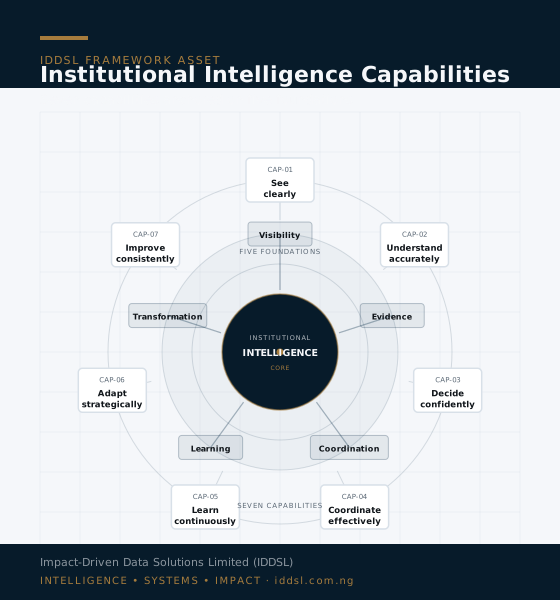
Institutional Intelligence is the ability of an organization to transform information, evidence, systems, operational knowledge, and experience into coordinated action, informed decision-making, continuous learning, and measurable performance improvement.
- Institutional Intelligence is not a technology.
- It is not a software platform.
- It is not a reporting system.
- Rather, it is an organizational capability.
Organizations with strong Institutional Intelligence are able to:
- See clearly
- Understand accurately
- Decide confidently
- Coordinate effectively
- Learn continuously
- Adapt strategically
- Improve consistently
Institutional Intelligence therefore represents an organizational capacity for perception, interpretation, coordination, learning, and action.
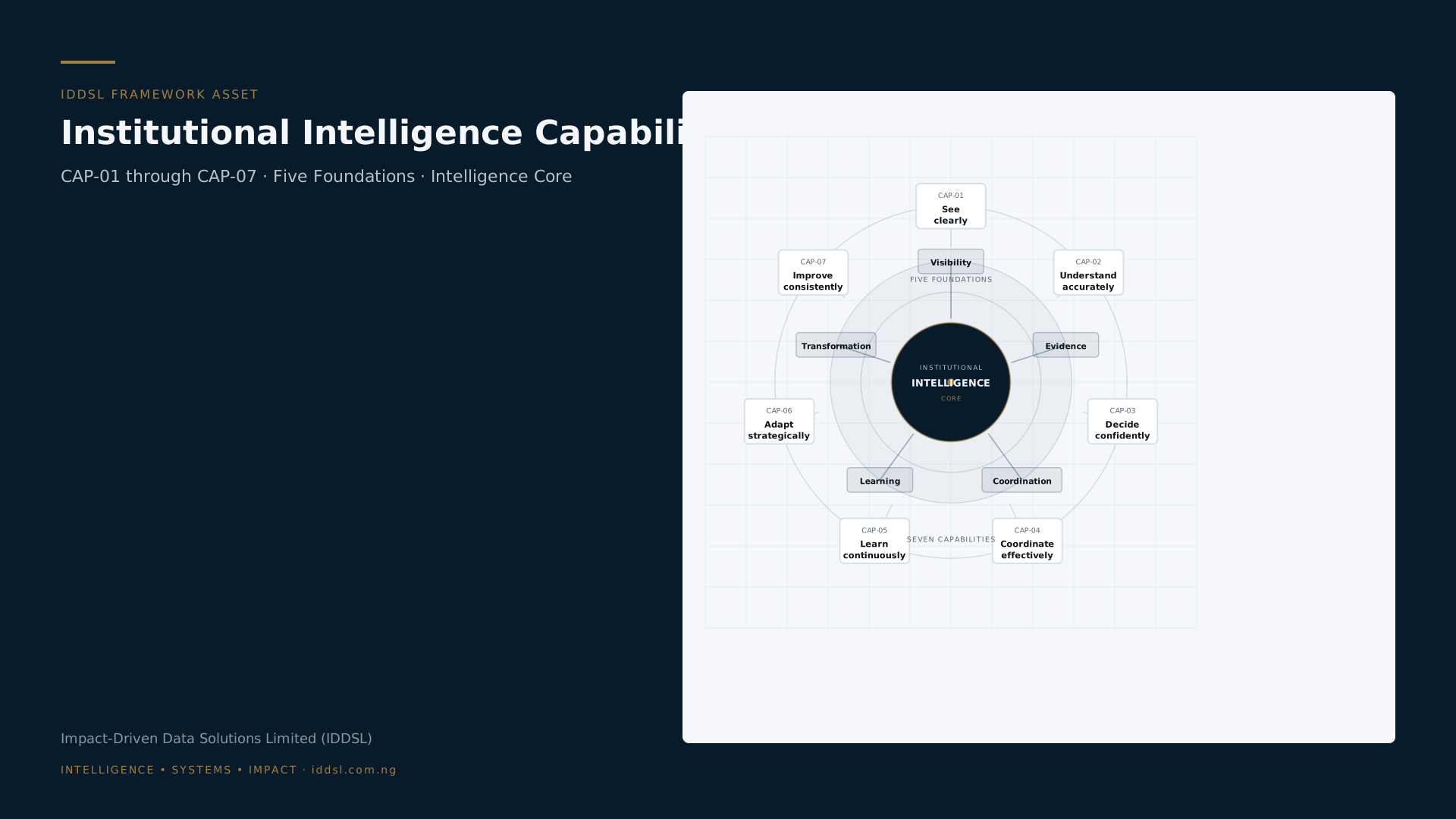
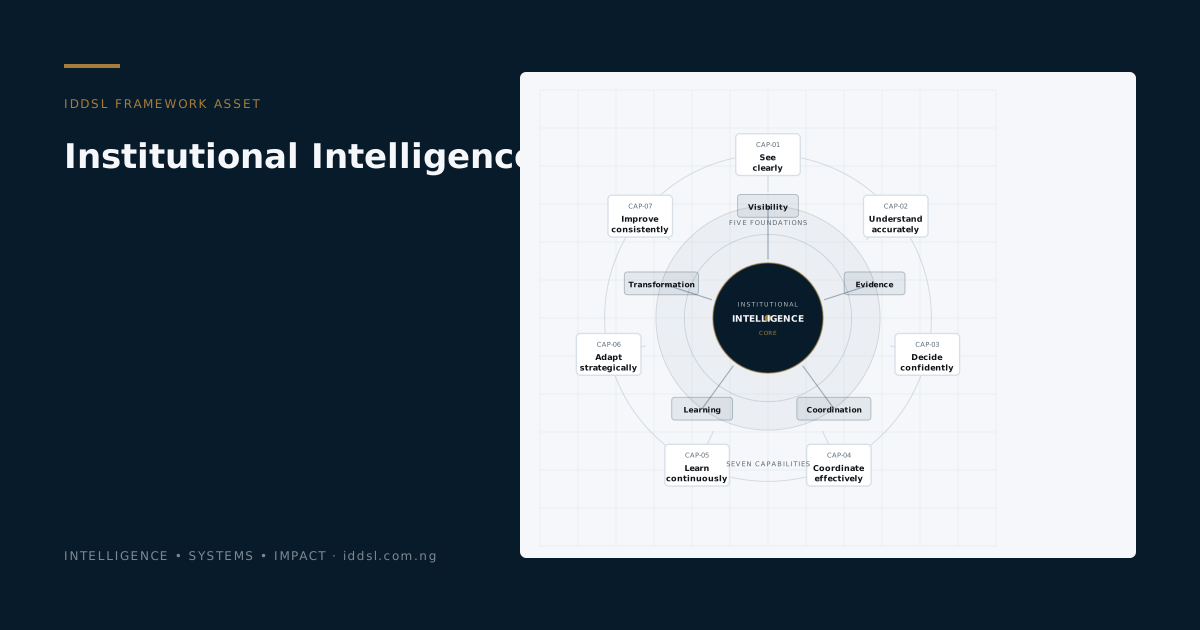
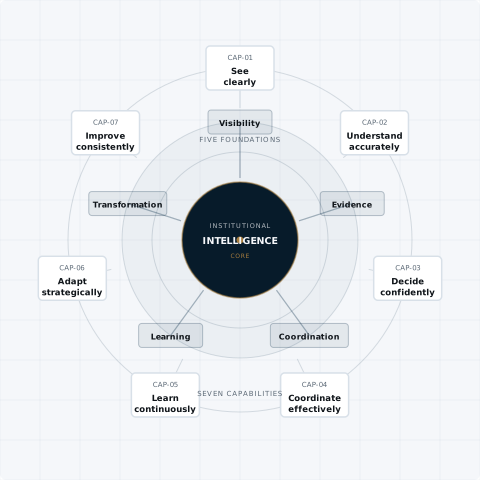
Figure 4.1
Institutional Intelligence Capabilities
Framework Asset · Institutional Intelligence Capabilities
Standalone vector assets for PDF, PowerPoint, LinkedIn, proposals, and web embedding.
Section 5
The Five Foundations of Institutional Intelligence
Figure 5.1
Institutional Intelligence Model
Visibility
The ability to observe and understand organizational realities.
Evidence
The ability to generate and use reliable information.
Coordination
The ability to align actors, systems, and processes.
Learning
The ability to improve through reflection and adaptation.
Transformation
The ability to implement and sustain meaningful change.
Together, these foundations create the conditions necessary for effective organizational performance.
Section 6
The IDDSL Intelligence Stack™
The IDDSL Intelligence Stack™ explains how organizations transform raw inputs into meaningful outcomes.
Figure 6.1
IDDSL Intelligence Stack™
Framework Asset · IDDSL Intelligence Stack™
Standalone vector assets for PDF, PowerPoint, LinkedIn, proposals, and web embedding.


Data
Raw observations, records, and measurements.
Information
Data organized into meaningful structures.
Insight
Interpretation of information that reveals patterns and relationships.
Intelligence
Contextualized understanding that supports decision-making.
Decision
Selection of a course of action.
Action
Implementation of decisions.
Impact
Observable changes resulting from action.
Many organizations perform adequately at the Data and Information levels but struggle to progress toward Intelligence, Decision, Action, and Impact.
The Intelligence Stack provides a framework for identifying and addressing these gaps.
Figure 6.2
Stack Maturity Gap
Section 7
The Operational Intelligence Framework™
While the Intelligence Stack explains how information becomes impact, the Operational Intelligence Framework™ explains how organizations strengthen Institutional Intelligence.
Figure 7.1
Stack and OIF Relationship
Figure 7.2
Operational Intelligence Framework™
Framework Asset · Operational Intelligence Framework™
Standalone vector assets for PDF, PowerPoint, LinkedIn, proposals, and web embedding.


Assessment
Understanding the current state.
Systems Mapping
Identifying actors, processes, information flows, and dependencies.
Intelligence Architecture
Designing structures that support visibility and decision-making.
Transformation Design
Creating interventions that improve organizational effectiveness.
Implementation
Executing transformation initiatives.
Monitoring & Optimization
Measuring performance and continuously improving systems.
Section 8
Institutional Intelligence in Practice
Institutional Intelligence can be applied across multiple contexts.
Figure 8.1
Sector Applications
SEC-01
Government
Coordination · Accountability · Service delivery
SEC-02
Development Organizations
Evidence use · Learning · Programme performance
SEC-03
Humanitarian Operations
Situational awareness · Operational coordination
SEC-04
Academic Institutions
Knowledge generation · Research · Learning
SEC-05
Enterprises
Visibility · Decision support · Performance
Government
Improving coordination, accountability, and service delivery.
Development Organizations
Strengthening evidence use, learning, and programme performance.
Humanitarian Operations
Enhancing situational awareness and operational coordination.
Academic Institutions
Improving knowledge generation, research management, and institutional learning.
Enterprises
Strengthening operational visibility, decision support, and performance management.
Section 9
Why Institutional Intelligence Matters
Organizations face growing complexity.
Success increasingly depends on the ability to:
- Process information effectively
- Learn continuously
- Coordinate efficiently
- Adapt strategically
- Deliver measurable results
Institutional Intelligence provides a framework for building these capabilities.
Organizations that strengthen Institutional Intelligence become more effective, resilient, accountable, and capable of achieving sustainable impact.
Section 10
Conclusion
The future of organizational performance will not be determined solely by technology, data availability, or resource levels.
It will be determined by how effectively organizations transform information into intelligence and intelligence into impact.
Institutional Intelligence offers a framework for understanding and strengthening this capability.
By improving visibility, evidence use, coordination, learning, and transformation, organizations can become better equipped to navigate complexity, improve performance, and achieve meaningful results.
For IDDSL, Institutional Intelligence is both a field of practice and a commitment to helping organizations operate with greater clarity, coherence, effectiveness, and impact.
About IDDSL
Impact-Driven Data Solutions Limited (IDDSL) is an Institutional Intelligence, Systems, Evidence, and Transformation firm that helps governments, development organizations, academic institutions, enterprises, and public-sector actors improve visibility, coordination, decision-making, learning, accountability, and organizational performance through systems, evidence, analytics, research, and transformation.
IDDSL is led by Umar Muhammad Yahaya, Founder & Principal, with strategic guidance from an Advisory Council and delivery through specialist Associate Experts assembled according to engagement requirements.
IDDSL operates through a networked delivery model that combines strategic leadership, advisory expertise, and specialist associates assembled according to the requirements of each engagement. This approach enables the firm to provide multidisciplinary capabilities while maintaining agility, quality, technical rigor, and responsiveness.
Contact
Impact-Driven Data Solutions Limited
Flat 2, Ayuba G House, Behind Alheri Hotel Karewa, GRA - Jimeta - Adamawa Nigeria
INTELLIGENCE • SYSTEMS • IMPACT
Citation
Publication Metadata
- Publication
- Institutional Intelligence
- Series
- IDDSL Working Paper Series
- Number
- WP-001
- Publisher
- Impact-Driven Data Solutions Limited (IDDSL)
- Publication Date
- May 2026
- Document Identifier
- IDDSL-WP-001
Impact-Driven Data Solutions Limited (IDDSL) (2026). Institutional Intelligence. IDDSL Working Paper Series, WP-001 (IDDSL-WP-001).
APA
Impact-Driven Data Solutions Limited (IDDSL). (2026). institutional intelligence: a framework for visibility, learning, decision-making, and performance (IDDSL Working Paper Series, WP-001, IDDSL-WP-001). Impact-Driven Data Solutions Limited (IDDSL). https://iddsl.com.ng/publications/institutional-intelligence-framework
BibTeX
@techreport{iddsl-wp-001,
  author = {{Impact-Driven Data Solutions Limited}},
  title = {Institutional Intelligence: A Framework for Visibility, Learning, Decision-Making, and Performance},
  institution = {Impact-Driven Data Solutions Limited (IDDSL)},
  series = {IDDSL Working Paper Series},
  number = {WP-001},
  year = {2026},
  month = {may},
  note = {Document Identifier: IDDSL-WP-001},
  url = {https://iddsl.com.ng/publications/institutional-intelligence-framework}
}